Too Happy for 3 A.M.: The Disturbing Pattern of America's Eerily Perfect Night-Shift Workers
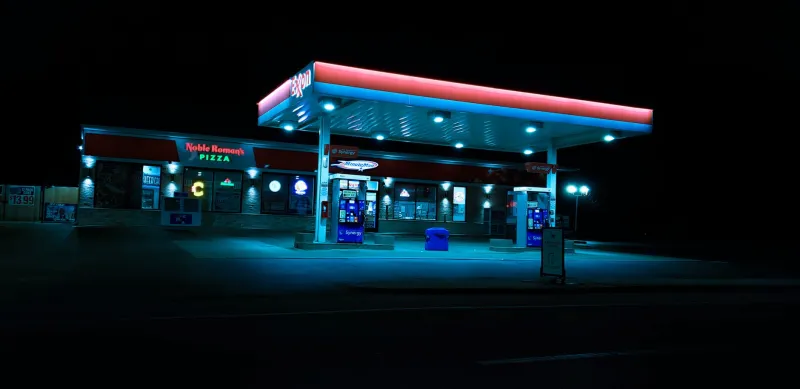
There is a particular quality to the world between two and four in the morning. The highways thin out. The fluorescent lights of roadside businesses burn with an almost surgical intensity against the surrounding dark. And somewhere inside those glowing interiors, a person stands behind a counter, smiling — waiting, it seems, with a patience that no ordinary human fatigue should permit.
For a growing number of late-night travelers and graveyard-shift workers across the United States, these encounters have become the subject of something more than casual unease. Forum threads, personal essays, and late-night Reddit confessions have accumulated into a quietly disturbing archive: stories of employees whose cheerfulness registers not as warmth, but as something hollow. Something rehearsed. Something wrong.
The Accounts That Started the Conversation
The reports follow a recognizable pattern. A solo driver pulls into a gas station somewhere off an interstate in rural Ohio at 3:15 a.m. The attendant behind the bulletproof glass is already looking at the door when the driver enters — not glancing up, but already looking, as though the arrival had been anticipated. The greeting is immediate, precise, and bright. Too bright. The attendant's smile does not shift during the entire transaction. When the driver thanks them and turns to leave, they report feeling watched in a way that prickled the back of the neck.
"It wasn't that he was threatening," one such account reads. "It was that he seemed genuinely delighted to be there at that hour, and that felt more frightening than anything threatening could have been."
Similar descriptions emerge from 24-hour diners in the Midwest, overnight pharmacies in the South, and the front desks of budget motels along the Eastern Seaboard. The details vary. The essential texture does not. The employee is unfailingly pleasant. Their energy is inexplicable given the hour. And there is, witnesses consistently report, something behind the eyes that does not quite match the performance of the face.
What Psychology Offers — and Where It Falls Short
The first and most rational framework for understanding these encounters involves the well-documented effects of sleep deprivation on human perception. When the body is pushed past its natural rest cycle, the brain begins to misread social cues. Neutral expressions can appear threatening. Ordinary behavior can seem choreographed or artificial. The phenomenon known as the "uncanny valley" — that deep discomfort triggered when something human-seeming is not quite human enough — becomes easier to activate when the observer's own cognitive defenses are worn thin.
From this perspective, the "too-perfect" night-shift worker may be an ordinary person doing their job competently, refracted through the distorted lens of an exhausted traveler's 3 a.m. mind.
And yet this explanation, while credible, does not fully account for the consistency of the accounts. Many of those who report these encounters were not, by their own description, severely sleep-deprived. Several were long-haul truckers accustomed to irregular hours, or emergency workers whose tolerance for nocturnal disorientation was well-established. The unease they describe does not read like hallucination. It reads like recognition — the instinctive sense that something in the social contract of the interaction has been quietly violated.
The Mask That Doesn't Move
Behavioral psychologists have long studied what is sometimes called "surface acting" — the labor of performing emotions one does not genuinely feel, a requirement endemic to customer-facing service roles. Research consistently shows that sustained surface acting carries a significant psychological cost, producing emotional exhaustion, depersonalization, and burnout.
But what witnesses describe in these late-night encounters is not the hollow performance of someone grinding through a difficult shift. It is, paradoxically, the opposite: a performance so seamless, so apparently effortless, that it stops resembling performance at all and begins to resemble something else entirely. A mask, perhaps. Or something wearing one.
One former overnight security guard, writing anonymously in an online forum dedicated to unexplained experiences, described a colleague who worked the 11 p.m. to 7 a.m. shift at a large commercial facility in the Chicago suburbs. "He was always the same," the account reads. "Always smiling. Always calm. I worked with him for eight months and I never once saw him eat, never saw him check his phone, never saw him look tired. I started coming in early just to watch him at the end of his shift. He clocked out the same way he clocked in. Like none of it had touched him."
Night as a Filter for the Uncanny
There is something the darkness does to ordinary things. It strips context. It removes the ambient social noise that allows us to process behavior as normal without consciously examining it. In daylight, a cheerful cashier reads as a cheerful cashier. At 3 a.m., the same behavior, stripped of its daytime scaffolding, can feel like a signal — a communication that does not quite resolve into meaning.
Folklorists and cultural anthropologists have noted that liminal spaces — thresholds, transitional zones, places that exist between defined states — have always carried a particular charge in human mythology. The gas station at the edge of a sleeping town. The diner where the highway ends. The hotel lobby at the hour when no sensible person should be checking in. These are, by their nature, spaces outside ordinary time, staffed by figures who exist, at least professionally, outside ordinary rhythms.
It is perhaps unsurprising that the people who inhabit those spaces, at those hours, begin to take on something of the uncanny character of the spaces themselves.
The Question That Remains
No definitive answer resolves these accounts cleanly. The psychological explanations are plausible but incomplete. The supernatural interpretations are evocative but unprovable. What persists, after every framework has been applied and found partially wanting, is the raw texture of the experience itself: the smile that does not waver, the eyes that seem to absorb rather than reflect, the feeling of having passed through an interaction that resembled normalcy in every visible detail while remaining, at some level beneath articulation, fundamentally other.
America runs on its night shifts. Millions of workers occupy those fluorescent-lit hours so that the rest of the country may sleep undisturbed. Most of them are simply tired people doing difficult work in the dark.
But somewhere out there, on some stretch of empty interstate you will drive alone, there is a counter with a light above it. And behind that counter, something is smiling.
It has been smiling, by all appearances, for a very long time.
And it will still be smiling long after you have gone.