The Buildings That Remember: Paranormal Reports from America's Forgotten Institutions
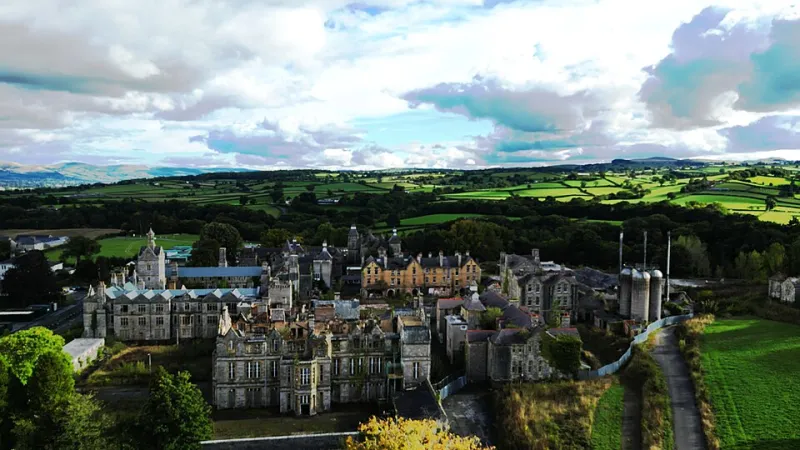
Photo: Llywelyn2000, CC BY-SA 4.0, via Wikimedia Commons
Consider the peculiar persistence of architecture. Long after the last patient has been discharged, the last student has graduated, the last file has been removed from the last cabinet, the building remains. Its walls hold the geometry of every interaction that occurred within them. Its floors have absorbed decades of footsteps. And if the accounts of urban explorers, paranormal investigators, and reluctant witnesses are to be believed, some structures retain something far more difficult to categorize than mere physical dimensions.
Abandoned American institutions occupy a unique position in the cultural imagination. They are not simply old buildings. They are former theaters of human extremity—places where people suffered, recovered, deteriorated, and died in concentrated numbers over extended periods. That specificity matters, both to those who study the psychology of place and to those who have walked through these spaces at night and returned with stories they cannot fully explain.
The Weight of Waverly Hills
Few abandoned structures in the United States carry a more documented history of reported paranormal activity than Waverly Hills Sanatorium in Louisville, Kentucky. Opened in 1910 as a tuberculosis treatment facility, the institution housed thousands of patients during the epidemic's peak decades. Conservative historical estimates suggest that as many as sixty-three thousand deaths occurred on the property over its operational lifetime—a figure that, if accurate, would make it one of the deadliest medical facilities in American history.
The building was repurposed as a geriatric care facility in 1962 before closing permanently in 1981. In the decades since, it has attracted an extraordinary volume of paranormal investigation, and the reports that have emerged follow patterns too consistent to dismiss as mere coincidence or coordinated fabrication.
Multiple independent investigators, visiting on separate occasions without prior coordination, have reported sounds originating from what was once the facility's body chute—a tunnel used to transport deceased patients discreetly from the building. Investigators describe footsteps, the sound of a door that no longer exists being opened and closed, and, in several documented cases, a low sustained vocalization that audio equipment has captured but that no acoustic engineer has satisfactorily explained.
More unsettling are the visual reports from the fourth floor, where the most severely ill patients were historically housed. Shadow figures—described consistently as tall, moving deliberately, and disappearing when approached—have been reported by dozens of visitors over a span of more than thirty years. The descriptions are, in their specificity, remarkably uniform.
What Place Memory Might Actually Mean
The scientific community does not, as a general rule, endorse the concept of haunting in its traditional sense. What it does offer, increasingly, is a framework for understanding why certain locations produce consistent psychological responses in the people who enter them.
The theory of place memory—sometimes called residual haunting in paranormal literature, and psychometric imprinting in more academically cautious circles—proposes that environments subjected to intense emotional events may retain some form of that intensity. The mechanism by which this might occur remains entirely speculative. But the phenomenology—the consistent reporting of similar experiences by unconnected individuals in specific locations—is harder to dismiss.
Dr. William Roll, a parapsychology researcher who spent decades studying reported hauntings, argued that certain buildings functioned as what he termed psi fields—environments in which the accumulated emotional residue of human experience created conditions that sensitive individuals could perceive. His work was never accepted by mainstream science, but it provided a vocabulary that many investigators have found more useful than simple debunking.
There is also the matter of infrasound—low-frequency sound waves below the threshold of human hearing that can be produced by aging HVAC systems, structural settling, and even specific wind conditions interacting with architectural features. Research has demonstrated that infrasound exposure at certain frequencies can produce feelings of unease, the sensation of being watched, and in some cases, visual disturbances. Many abandoned institutions, with their deteriorating mechanical systems and vast empty spaces, are precisely the environments where infrasound is most likely to be generated.
This explanation satisfies some of what gets reported. It does not satisfy all of it.
The Ridges and the Records That Remain
The Ridges, formerly known as the Athens Lunatic Asylum in Athens, Ohio, operated from 1874 until 1993. During its operational decades, it housed patients under conditions that ranged from genuinely therapeutic to profoundly inhumane, as was common for psychiatric institutions of the era. Lobotomies were performed. Patients were restrained. The isolation wards, by historical account, were places of considerable suffering.
The most frequently cited incident associated with The Ridges is not a matter of paranormal dispute—it is documented fact. In December 1978, a patient named Margaret Schilling went missing within the facility. Her body was discovered forty-two days later in an abandoned ward. The stain her body left on the concrete floor proved indelible; despite repeated attempts to remove it, the outline remained visible for decades and is still partially discernible today.
Urban explorers who have visited The Ridges—portions of which now house Ohio University offices and academic facilities—report experiences concentrated in the wards farthest from active use. The accounts include the smell of antiseptic in rooms where no cleaning has occurred in years, the sensation of hands on shoulders in empty corridors, and voices heard through walls that, upon investigation, open onto unoccupied spaces.
One explorer, writing in a widely circulated online account from 2019, described spending three hours in the facility's upper isolation ward before retreating. She noted that her audio recorder had captured, during a period of complete silence, what sounded unmistakably like a woman counting quietly in a voice that grew louder as the playback continued. She returned to the ward the following afternoon, in daylight, and heard nothing.
The Schools That Should Be Quiet
It is not only hospitals and asylums that generate these reports. Abandoned schools carry their own specific weight, and the testimonies they inspire have a quality distinct from those associated with medical facilities—less overtly threatening, somehow, but more persistently melancholy.
Gary, Indiana's Emerson Visual and Performing Arts School, shuttered in 2008 as the city's population continued its long decline, has become one of the most photographed abandoned structures in the Midwest. Photographers and explorers who have documented its interior describe a consistent phenomenon: the sound of children's voices in the gymnasium and the lower hallways. The voices are never intelligible. They are described as the ambient sound of children at play—a collective murmur, punctuated occasionally by what sounds like laughter.
No children have been in the building in over fifteen years.
The Question That Persists
Whether one approaches these accounts as a skeptic, a believer, or something more genuinely uncertain, the testimonies demand a response that simple dismissal cannot adequately provide. Too many people, in too many locations, over too many years, have reported experiences that share too many specific features to be explained away entirely by suggestion, fabrication, or the well-documented human tendency to find pattern in noise.
What abandoned American institutions appear to offer—whatever the ultimate explanation—is a concentrated encounter with the weight of the past. The suffering that occurred in these places was real. The people who experienced it were real. And the buildings that contained them still stand, holding their geometry, their silence, and whatever it is that refuses, even now, to fully depart.