Dead Air: The Haunted Frequencies Still Whispering from America's Abandoned Radio Towers
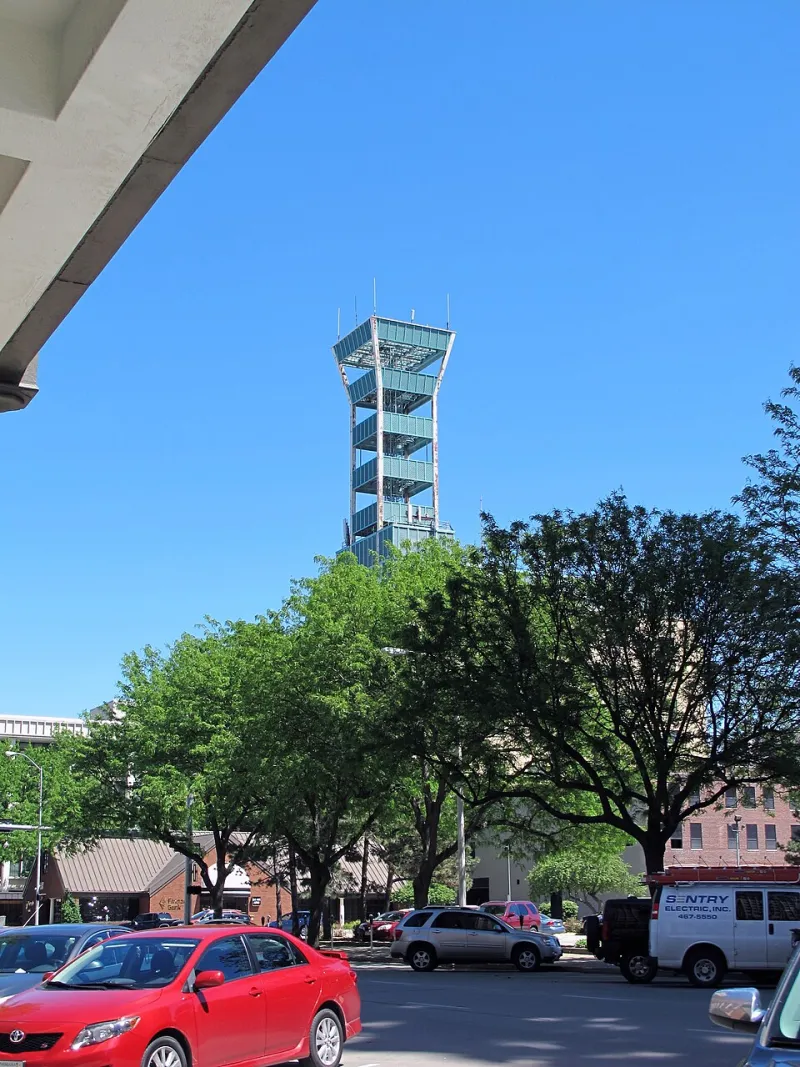
Photo: Hanyou23, CC BY-SA 4.0, via Wikimedia Commons
There is a particular kind of silence that belongs exclusively to abandoned places — not the comfortable quiet of an empty room, but something heavier, more deliberate. It presses against the eardrums with an almost physical weight. Urban explorers who have ventured beneath the rusted lattice frames of America's derelict radio towers describe that silence as the loudest thing they have ever heard. And then, without warning, the silence breaks.
Across the continental United States, hundreds of radio transmission sites have been decommissioned over the past several decades. Regulatory changes, the transition to digital broadcasting, and the consolidation of media ownership have rendered vast swaths of analog infrastructure obsolete. The towers themselves — some stretching hundreds of feet into the rural sky — are frequently too expensive to demolish and too remote to monitor. They are simply left. And in that abandonment, something curious has taken root.
The Architecture of Desertion
The geography of America's abandoned radio towers follows a logic shaped by early Federal Communications Commission licensing requirements. Powerful AM stations, in particular, required significant land buffers and were often constructed on the rural fringes of mid-sized cities — in marshlands, cornfields, and pine barrens where the soil conductivity enhanced signal propagation. When those stations went dark, the towers remained standing in landscapes that were already predisposed to isolation.
Kearney, Nebraska. Bithlo, Florida. The hill country west of Waco, Texas. These are not places where casual visitors wander. The access roads become unpaved within a mile of the sites, and the structures themselves are frequently surrounded by chain-link fencing that has long since been breached by weather, vandalism, or time. What greets those who push past the perimeter is a tableau of arrested decay: transformer housings split open by rust, ceramic insulators shattered across cracked concrete pads, and the towers themselves — skeletal, improbable, still somehow standing.
It is within these compounds that the reports begin.
Signals from Nowhere
In 2019, a small-scale hobbyist radio operator in central Illinois documented what he described as a structured transmission emanating from the frequency previously assigned to a station that had surrendered its license fourteen years earlier. The signal, he noted in a post that circulated briefly through shortwave enthusiast forums before being archived, carried what sounded like a looping segment of a broadcast — a weather report, a fragment of a man's voice reading agricultural commodity prices — before dissolving into static. The FCC, when contacted, found no record of any authorized transmission on that frequency.
This incident, while singular in its documentation, is far from isolated. Collectors of unexplained radio phenomena — a community that occupies the overlap between amateur electronics enthusiasts and paranormal researchers — have catalogued dozens of similar reports across the past two decades. A recurring detail in these accounts is the quality of the audio itself: the voices, when intelligible, carry the sonic signature of mid-century analog equipment. Compression artifacts, frequency drift, the faint warble of aging tape. Whatever is being transmitted sounds old in a way that modern equipment, even when deliberately mimicking vintage broadcast aesthetics, does not quite replicate.
Skeptics, and there are credible ones, point to a phenomenon known as intermodulation distortion, in which aging passive components within abandoned transmission equipment can, under specific atmospheric conditions, re-radiate ambient signals in distorted form. It is a plausible explanation. It does not fully account for the content.
What the Explorers Found
The urban exploration community — practitioners of what its members call "urbex" — has documented dozens of visits to abandoned transmission sites, and the accounts that circulate through their forums and video channels carry a consistency that is difficult to dismiss as coordinated fabrication.
A team of three explorers who visited a decommissioned AM tower complex in the Mississippi Delta in 2021 reported that their radio scanner, set to sweep open frequencies, locked onto a signal approximately forty minutes into their visit. The transmission lasted eleven seconds. What they recorded — and subsequently posted with minimal commentary — is a segment of audio in which a woman's voice reads what appears to be a list of proper names, each separated by a brief pause, before the frequency returns to static. The names are unremarkable. The calmness of the delivery is not.
Another account, this one from a solo explorer who visited a derelict transmission site in the Appalachian foothills of western North Carolina, describes a more visceral encounter. She reported that upon entering the main transmitter building — a low cinderblock structure whose roof had partially collapsed — she experienced an acute sensation of being observed, followed by what she described as a sound emanating from within the walls themselves: a low, rhythmic hum that did not correspond to any mechanical source she could identify. Her photographs from the interior, she noted, contained a visual artifact she could not explain — a pale elongation in the corner of one frame that was not present in the image taken immediately before or after it.
The Legends That Grew in the Static
Local communities adjacent to these sites have, over time, constructed their own interpretive frameworks for the strangeness that seems to emanate from them. In rural parts of the Midwest and the Deep South particularly, where the relationship between landscape and memory runs deep, abandoned towers have accrued folklore the way old wood accrues rot — slowly, inevitably, and from the inside.
In one small Kansas county, the story persists that a night-shift engineer who worked at a regional AM station in the 1960s died at his post during a severe thunderstorm, and that his voice — clipped, professional, reading the overnight farm report — can still be heard on certain evenings when the atmospheric pressure drops sharply. The station's call letters no longer exist. The tower still does.
Whether these legends represent genuine folk memory, the human mind's compulsion to impose narrative on the inexplicable, or something else entirely is a question that resists clean resolution.
The Frequency of the Unknown
What is perhaps most unsettling about America's abandoned radio towers is not any single documented incident but rather the cumulative weight of the accounts, their geographic spread, and the degree to which they echo one another across communities with no apparent connection. Voices from equipment that should be incapable of producing them. Sounds without mechanical origin. Visual anomalies in photographs taken at sites where nothing visible could have produced them.
The rational mind reaches, as it must, for rational explanations: atmospheric propagation anomalies, pareidolia, the suggestibility of people who enter already-charged environments expecting the uncanny. These explanations are not wrong. They are simply, in certain cases, insufficient.
The towers continue to stand. The frequencies they once owned remain assigned in the FCC database, ghostly reservations held by entities that no longer exist. And in the hours before dawn, when the ionosphere shifts and AM signals travel farther than they have any right to, something occasionally reaches out across the dead air.
Whether it reaches back is a matter of how closely one is willing to listen.