Clocked In Forever: The Ghostly Highway Workers Who Never Seem to Leave Their Posts
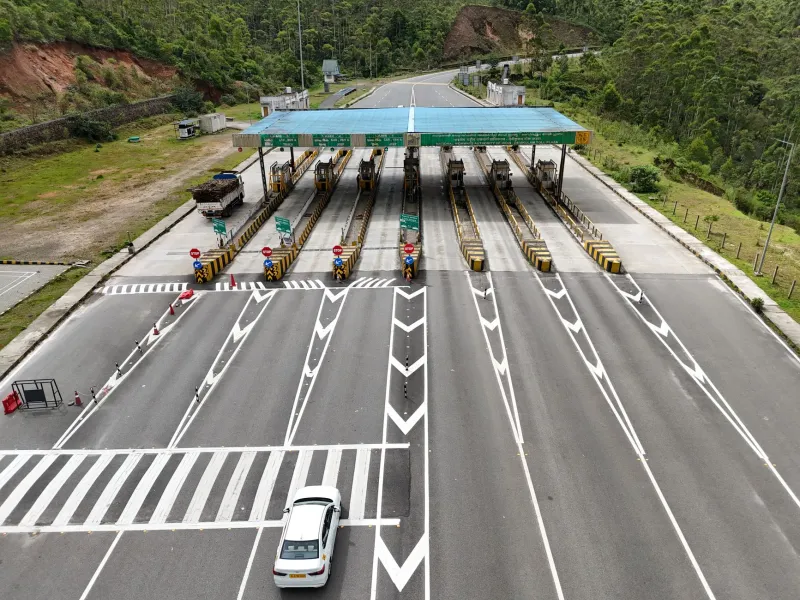
There is something inherently unsettling about America's highways after midnight. The white dashes blur into a hypnotic ribbon, the radio fades to static, and the only signs of civilization are the pale orange pools of light hovering above toll plazas and rest stop turnoffs. For most drivers, these lonely outposts represent nothing more than a brief, transactional pause in an otherwise anonymous journey. But for a growing number of travelers — and, more disturbingly, for the maintenance crews and state transportation employees who work alongside them — these roadside fixtures have become the setting for encounters that defy rational explanation.
The reports are remarkably consistent. A toll booth attendant, always on the graveyard shift, always in the same lane. A face that hasn't changed in fifteen years. A name badge that reads the same as it did when a driver first passed through in 2004, then again in 2011, then again last spring. No retirement. No promotion. No absence. Just the same figure, illuminated by the same fluorescent glow, extending the same weathered hand for exact change.
The Accounts That Started the Conversation
The first serious aggregation of these reports appeared not in a government filing or a newspaper investigation, but in an online trucking forum in 2018. A long-haul driver from Ohio posted a brief, almost apologetic entry describing an attendant he had encountered at a toll plaza on I-76 every few months for over a decade. The man — heavyset, with a gray-streaked mustache and a Pennsylvania DOT vest — had not visibly aged a single day since the driver's first pass-through in 2007. The post attracted dozens of replies within forty-eight hours, many from other commercial drivers describing nearly identical experiences at toll plazas stretching from the New Jersey Turnpike to the outskirts of Chicago.
What made these accounts particularly difficult to dismiss was their specificity. These were not impressionistic ghost stories told around a campfire. They were precise, timestamped, and corroborated by independent observers who had no prior contact with one another. Several drivers had even photographed the attendants in question — images that, when compared across years, showed no discernible change in the subjects' appearance.
A retired highway patrol officer from western Pennsylvania, who asked not to be identified by name, described his own experience in terms that were considerably more unsettling. "I worked the overnight detail on a stretch of I-79 for eleven years," he said. "There was a maintenance worker — always the same man, always walking the same quarter-mile of guardrail between two in the morning and four. I asked my supervisor about him once. He told me the guy had been on that stretch since the eighties. When I asked who he reported to, the conversation just... stopped."
Employment Records That Circle Back to Nowhere
Perhaps the most unnerving dimension of these reports is what happens when anyone attempts to verify the employment histories of the workers in question. Journalists, amateur investigators, and at least two state-level FOIA requests have encountered what can only be described as administrative loops — personnel files that reference themselves, hire dates that predate the existence of the facilities where the workers are stationed, and supervisors who, upon inquiry, turn out to have retired or died years prior.
One researcher who spent several months pursuing records related to a specific toll attendant on the Illinois tollway described the experience as "bureaucratically vertiginous." Every document she obtained pointed to another document. Every supervisor named in a file was listed as reporting to a department that had been dissolved. "It wasn't that the records were falsified," she noted. "It was more like they had been designed to prevent any terminal point. You could follow the paper trail forever and never arrive anywhere."
State transportation departments, when contacted for comment, have universally declined to address specific cases, citing personnel privacy regulations. This is, on its surface, a reasonable response. But privacy protections do not typically explain why certain workers appear in internal rosters dating back forty years with no corresponding retirement, resignation, or death notation of any kind.
The Temporal Anomaly Hypothesis
Within the community of researchers who take these accounts seriously, two primary explanations have gained traction. The first is bureaucratic negligence — the possibility that certain workers have simply fallen through the cracks of an underfunded, understaffed system, and that what appears supernatural is merely the product of poor record-keeping and the human tendency to find pattern in coincidence.
The second explanation is considerably harder to rationalize away.
Several researchers with backgrounds in theoretical physics and consciousness studies have proposed that certain stretches of American highway infrastructure — particularly those built during the rapid interstate expansion of the 1950s and 1960s — may occupy what they describe as "temporal seams": locations where the normal progression of time is subtly disrupted by a confluence of electromagnetic conditions, geological anomalies, and the sheer density of human psychic residue left by decades of transit and tragedy.
In such locations, the theory suggests, certain individuals — those who arrive at a specific psychological threshold of isolation, repetition, and detachment — may become, in some sense, fixed. Not dead. Not entirely alive in any conventional sense. Simply present, performing the same function, inhabiting the same narrow band of nocturnal routine, unable or unwilling to step beyond the boundaries of their post.
It is a theory that sounds, in daylight, entirely implausible. At two in the morning, on a deserted stretch of interstate with nothing ahead but darkness and nothing behind but the receding glow of a toll booth, it sounds considerably less so.
What the Night Shift Knows
The workers themselves — the living, documented ones who share shifts with these anomalous figures — are rarely eager to discuss what they have observed. Those who do speak tend to do so in hushed, careful language, as though the act of articulating the experience might somehow solidify it into something they are not prepared to confront.
A toll booth supervisor in New Jersey, speaking anonymously, offered perhaps the most precise description of the phenomenon. "You learn not to ask certain people about their weekend, because they don't have one. You learn not to ask how long they've been working here, because the answer doesn't make sense. You just take the shift handoff and you go home. And you're grateful," she paused, "that you can."
America's highway system is, in many respects, the circulatory system of the nation — a vast, ceaseless network of movement, commerce, and transit. It operates around the clock, staffed by an army of workers whose labor is largely invisible to the millions who depend upon it. Most of those workers go home. Most of them age. Most of them, eventually, leave.
But not all of them.
Somewhere out there, on a stretch of interstate that looks like every other stretch of interstate, a figure stands beneath a fluorescent light, hand extended, waiting for the next car to slow. The same figure who stood there last year. And the year before that. And the decade before that.
The darkest hour is always near on roads like these. And some of the people watching over them may have been watching for a very long time.