Behind the Counter After Midnight: The Night-Shift Hospitality Workers Who Never Seem to Leave
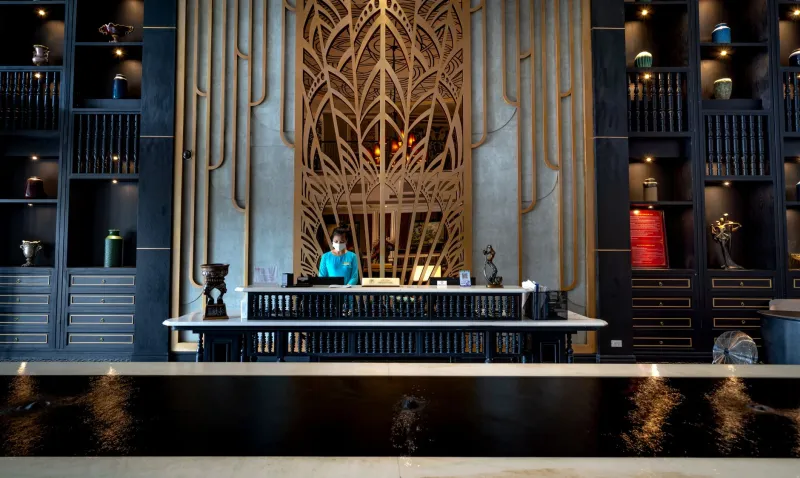
There is a particular quality to the silence of a hotel lobby at three in the morning. The overhead lights hum just slightly too loud. The potted plants stand at attention like sentinels. And behind the front desk, bathed in the pale glow of a monitor screen, someone is always smiling at you.
Always.
For most travelers, that presence is a comfort — proof that the world has not entirely abandoned them in the small hours. But for a growing number of Americans who log significant time on the road, the comfort has curdled into something far more troubling. They are not reassured by the smiling face behind the counter. They are frightened by how familiar it looks.
The Accounts That Started Quietly
The testimonies did not arrive in any organized fashion. They surfaced gradually — in travel forums, in Reddit threads, in the comment sections of articles about long-haul trucking and late-night business travel. A sales representative from Columbus, Ohio, described checking into a Marriott property in Phoenix and recognizing the concierge with an inexplicable certainty. She had last stayed at that particular chain location in Nashville, Tennessee — three years prior. The man behind the desk wore the same pressed uniform, the same practiced expression, and appeared not one day older. When she mentioned the Nashville property in conversation, he responded with the kind of smooth, deflecting warmth that hospitality professionals are trained to deploy. The subject was changed before she could press further.
A retired long-haul driver from rural Georgia shared a similar account on a trucking community forum in 2021. He described pulling into a 24-hour diner off Interstate 40 in New Mexico and being greeted by a waitress he was absolutely certain had served him at a comparable establishment in western Tennessee more than a decade earlier. Same posture. Same cadence to her speech. Same small silver pin on her uniform lapel — a detail he remembered because, he noted, it was shaped like a moth.
These stories, taken individually, invite easy dismissal. Human memory is fallible. Hospitality staff are trained to present a consistent, branded demeanor. Uniforms homogenize appearance. And yet the accounts keep accumulating, and the details within them resist the comfortable explanations.
Employment Records and the Gaps Within Them
Several researchers and amateur investigators have attempted to verify the claims through publicly available employment data and corporate HR disclosures. What they have encountered is not evidence of fraud, precisely, but rather an unusual prevalence of what one might call administrative opacity.
Casino properties along the Las Vegas Strip, for instance, employ thousands of overnight workers whose tenure records are rarely made available to the public. Union contracts in the hospitality sector often contain provisions that limit the disclosure of individual employment histories. When one independent researcher filed public records requests with Nevada's labor board seeking aggregate data on overnight hospitality worker turnover rates, the figures returned were notably lower than those reported for day-shift equivalents — by a margin that labor economists interviewed for this piece described as statistically irregular.
None of this constitutes proof of anything supernatural. It does, however, suggest that the overnight hospitality labor pool operates with a degree of insularity that the broader industry rarely examines.
The Consistency of the Smile
Perhaps the detail that recurs most insistently across eyewitness accounts is not the faces themselves, but the expressions those faces carry. Travelers who have grown unsettled by repeat encounters describe not hostility, not blankness, but an unvarying, calibrated warmth that feels, after extended observation, deeply wrong.
A psychologist specializing in social cognition, when presented with these accounts without attribution, offered a term for the phenomenon: affective uncanny valley. The concept, adjacent to the better-known robotics theory, suggests that human beings possess an intuitive sensitivity to emotional authenticity. When a smile is held too long, when warmth is delivered without variation across wildly different interactional contexts, the subconscious registers an alarm that the conscious mind struggles to articulate.
"We are wired to read micro-expressions, subtle fatigue, the small emotional leakage that tells us another person is genuinely present," she explained. "When those signals are absent — when the performance is too clean — something in us recoils, even if we cannot name why."
Night travelers, by virtue of the hour, are already operating at reduced cognitive capacity. The darkness strips away the ambient social noise that ordinarily distracts us. What remains is a heightened, almost predatory attentiveness — and it is in this state that the wrongness behind the counter becomes most visible.
Cities, Years, and the Same Familiar Face
Of all the accounts gathered in the preparation of this piece, one stands apart for the precision of its detail. A travel writer based out of Chicago — who requested anonymity, citing professional concerns — described a sequence of encounters spanning eleven years and seven states. She had, she explained, made a habit of noting the name tags of overnight staff at the properties she reviewed. It was, she said, a small act of humanizing journalism in an industry that often rendered service workers invisible.
Over the course of her career, she had recorded the same first name — Gerald — appearing on the badges of overnight front desk staff at properties in Portland, Oregon; Memphis, Tennessee; Albuquerque, New Mexico; and, most recently, a boutique hotel in Savannah, Georgia. In each instance, the man wearing the badge matched a consistent physical description: average height, pale complexion, dark hair swept neatly to one side, and eyes that she described, with evident discomfort, as "the color of water in a very deep place."
She had, on the Savannah occasion, asked directly whether he had ever worked in Portland. He had smiled — that smile — and told her that he had always been exactly where he was needed.
She checked out at dawn.
What the Darkness Employs
There is no tidy conclusion to offer here. The phenomenon documented in these accounts does not resolve into a single explanation, whether rational or otherwise. What it does suggest is that the hours between midnight and sunrise constitute a territory with its own rules — a liminal space where the ordinary structures of labor, identity, and time appear to operate by principles not fully legible to the daylight world.
America's night-shift hospitality workers occupy a peculiar social position. They serve those of us who exist, temporarily and by necessity, outside the rhythms of normal life. They are present when we are most vulnerable — exhausted, disoriented, far from home. They smile because they are paid to smile, or because something else entirely has taught them to.
The next time you find yourself standing at a hotel desk at three in the morning, studying the face of the person handing you your key card, ask yourself one honest question: does that smile reach the eyes?
And if it does not — if what looks back at you from behind the counter seems to be watching rather than welcoming — perhaps the wisest course is to take your key, go to your room, and do not look back down the hallway.
Some doors, once noticed, are better left unopened.