Monsters in the Margins of Sleep: How America's Silent Breathing Crisis Is Summoning Shadows at 3 A.M.
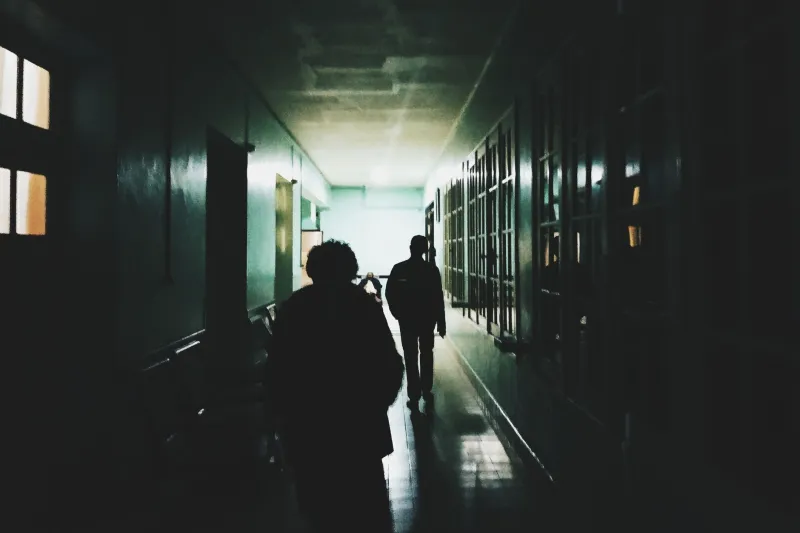
There is a specific quality to the darkness that exists between one breath and the next. Most people never notice it. For the estimated 39 million Americans living with undiagnosed or undertreated sleep apnea, however, that darkness is not empty. It is occupied.
The reports follow a pattern that has become disturbingly familiar to researchers, sleep clinicians, and the growing community of Americans who share their experiences in late-night forums when the rest of the household is unconscious. A figure stands in the corner of the room. A weight descends onto the chest with crushing, deliberate force. A presence breathes — or rather, does not breathe — somewhere just beyond the peripheral edge of vision. And then, as suddenly as it arrived, it is gone, leaving the sufferer gasping, drenched in cold perspiration, utterly certain that what they witnessed was real.
Medical literature has a name for the threshold state in which these encounters occur. The question that lingers, unanswered and perhaps unanswerable, is whether that name fully explains what is happening inside America's darkened bedrooms.
The Architecture of a Waking Nightmare
Sleep apnea, at its most fundamental, is a disorder of interrupted respiration. The airway collapses or becomes obstructed during sleep, oxygen levels drop, and the brain — registering an emergency — partially rouses the sleeper to restore normal breathing. This cycle can repeat dozens, sometimes hundreds, of times per night, trapping the sufferer in a perpetual, exhausting limbo between genuine sleep and full wakefulness.
It is precisely within this limbo that the neurological conditions for terror are most perfectly assembled.
Hypnagogic and hypnopompic hallucinations — those occurring at the onset of sleep and upon waking, respectively — are well-documented phenomena associated with disrupted sleep architecture. When the brain is repeatedly yanked from deeper sleep stages without completing the full transition to consciousness, sensory processing becomes unreliable in ways that are not merely uncomfortable but profoundly disturbing. Visual cortex activity continues in patterns consistent with REM dreaming. Auditory processing generates sounds from silence. The body's threat-detection systems, deprived of adequate rest, operate in a state of heightened and indiscriminate alarm.
The result, for a significant portion of sleep apnea sufferers, is an experience that bears no resemblance to a simple bad dream. It feels, by every available internal measure, like an intrusion.
What the Sufferers Describe
Dr. Nathaniel Bryce, a sleep medicine specialist practicing in Atlanta, Georgia, has treated thousands of apnea patients over the course of his career. He describes a consistent pattern in the hallucination reports he receives — one that he finds both clinically explicable and, in his own words, "genuinely unsettling to hear repeated so precisely by people who have never met one another."
The shadow figure is the most commonly reported entity. It stands at the periphery of the room, usually near a doorway or window, and it does not move until the moment the sufferer attempts to focus directly upon it. Then it is simply absent — not retreating, not dissolving, but erased between one labored breath and the next.
The chest presence is the second most frequently described phenomenon. Sleep paralysis, which frequently accompanies the hypnopompic state, renders the body temporarily immobile, and the brain's interpretation of this paralysis — combined with the genuine physical sensation of a compromised airway — produces the overwhelming tactile certainty of something sitting, pressing, or holding the sleeper down. Across centuries and cultures, this experience has generated the Old Hag, the Incubus, the Mare. In twenty-first century American bedrooms, it generates 911 calls, emergency room visits, and thousands of posts in online communities dedicated to the paranormal.
Marcella Odom, a 44-year-old schoolteacher from rural Tennessee, was diagnosed with severe obstructive sleep apnea in 2021 after more than a decade of what she had come to understand as nightly visitations. "I had seen a priest," she states flatly. "I had burned sage. I had done everything that anyone suggested. And every single night, something came into that room and stood over me while I couldn't move." Her diagnosis, and subsequent treatment with a CPAP device, eliminated the encounters entirely within three weeks. She describes the relief as profound and the implications as deeply troubling. "If it was just my brain," she says, "then my brain was producing something indistinguishable from evil."
The Rational Explanation That Doesn't Fully Satisfy
The medical community's position is clear, consistent, and well-supported by research. Oxygen desaturation during apneic episodes directly impairs the prefrontal cortex's ability to distinguish between internally generated imagery and external reality. The amygdala, the brain's primary fear-processing center, operates with diminished regulatory oversight during these partial-arousal states, producing threat responses that are physiologically identical to those generated by genuine danger. The shadow figures are misfired pattern recognition. The chest pressure is paralysis misinterpreted. The dread is cortisol and adrenaline moving through a system that cannot properly contextualize them.
This explanation is, by every scientific standard, correct.
And yet it does not entirely satisfy, for reasons that those who study the outer edges of human experience find worth examining. The specificity of the hallucinations — the recurring figure in the corner, the identical pressure on the chest, the particular quality of malevolence that sufferers describe with strikingly uniform language — raises questions that pure neurological mechanics do not wholly address. If these experiences are generated internally, why do they so consistently produce the same external forms? Why does the brain, left to its own disordered devices in the small hours of the American night, so reliably manufacture the same ancient shapes?
When the Darkness Has a Diagnosis
There is a grim irony embedded in the sleep apnea hallucination phenomenon. The disorder is vastly underdiagnosed — the American Academy of Sleep Medicine estimates that roughly 80 percent of moderate to severe cases go undetected. This means that an enormous number of Americans are currently experiencing recurring, medically induced encounters with shadow figures, demonic presences, and states of paralyzed terror, and attributing those experiences to sources that have nothing to do with their airway.
The consequences extend beyond sleepless nights and frayed nerves. Sufferers report lasting anxiety, disrupted relationships, and a pervasive, corrosive sense that their home environment is contaminated by something hostile. Some relocate. Some seek spiritual intervention. Some simply endure, night after night, convinced that they are being visited by something that medical science cannot account for — when, in fact, medical science has already written a very precise and very unglamorous account of exactly what is happening to them.
This is not to diminish the experience. A hallucination that produces genuine terror, genuine paralysis, and genuine physiological crisis is not rendered harmless by the identification of its neurological mechanism. The darkness that fills the space between stopped breaths is real darkness, regardless of what casts it.
The Question That Remains
America's sleep apnea epidemic and its attendant nocturnal horrors exist at a peculiar intersection — the point where the explicable and the inexplicable press their faces against the same cold glass. Medicine offers a mechanism. It does not offer certainty about what that mechanism may, in its disordered firing, inadvertently illuminate.
The sufferers who have been treated, whose shadow figures vanished with their first successful night of uninterrupted breathing, are left with a question that no CPAP machine addresses: what was it, exactly, that their oxygen-starved brains were so consistently reaching for in the dark? What ancient template does the disordered mind return to, again and again, when the airway closes and the silence stretches between the breaths?
The darkest hour is near, and for millions of Americans, it arrives not at midnight but in the space of a single stopped breath — a space that, for reasons science can measure but perhaps not fully explain, refuses to remain empty.