After the Anthem Ends: The Disturbing Things Americans Are Seeing When Late-Night Television Goes Dark
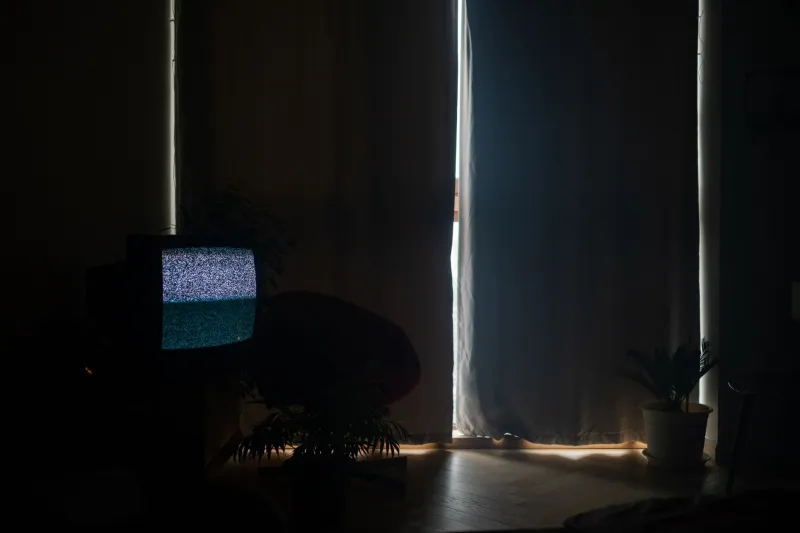
There is a particular quality of silence that descends upon a household at three in the morning when the television screen shifts without warning. Not the comfortable silence of sleep, but the kind that presses against the ears — weighted, expectant, as though something on the other side of the glass is waiting to see whether you are still paying attention.
For decades, American television stations maintained a ritual as reliable as sunrise. The programming concluded. A flag waved over a military march or a sweeping orchestral rendition of the national anthem. A calm announcer's voice wished the audience a good night. Then came the test pattern — that familiar geometric target, ringed in color bars — followed by the steady, droning tone that served as the broadcast equivalent of a closed door. It was orderly. It was predictable. It was, in its own way, deeply human.
But something has changed. And the people who are awake to witness it are not entirely sure what to make of what they have seen.
The Ritual That No Longer Holds
The formal sign-off is largely a relic of the twentieth century. The proliferation of cable, satellite, and streaming services transformed television into an unbroken river of content, theoretically endless. Most major network affiliates abandoned scheduled closures years ago, filling dead hours with infomercials, syndicated reruns, and automated programming blocks.
Yet certain regional stations — particularly independent affiliates, public access channels, and low-power broadcasters scattered across rural America — still observe something resembling the old tradition. It is in these margins, these overlooked corners of the broadcast spectrum, that the reports have begun to accumulate.
According to accounts gathered from online forums, insomniac communities, and overnight workers who monitor ambient television as background noise, the anomalies tend to follow a recognizable pattern. A station's scheduled content ends. The expected sign-off sequence begins. And then, somewhere between the final frame of programming and the arrival of the test tone, something appears that was never supposed to be there.
Faces in the Frequency
A woman in rural Ohio — a licensed practical nurse who works overnight shifts and leaves the television on for company during her off hours — described the experience in considerable detail during an interview conducted for this article. She asked that her name not be published.
"The station I watch goes to a test pattern around two-thirty," she explained. "I've seen it hundreds of times. But one night last February, there was a face. Just for a second, maybe two. A man's face, pale, looking directly at the camera. No expression. Then the tone came on like nothing happened."
She reported the incident to the station's public contact line. She received no response.
Her account is not unique. A retired schoolteacher in western Tennessee described seeing what appeared to be handwritten text scrolling across a blank screen during a sign-off sequence — text that moved too quickly to be read in full, though she caught fragments she described as "coordinates or numbers, like a map reference." A former overnight security guard in Albuquerque, New Mexico, recounted hearing a voice speaking beneath the test tone, low and deliberate, reciting what sounded like a list of names.
These testimonies are, individually, easy to dismiss. Fatigue distorts perception. The human brain, deprived of stimulation during the darkest hours, reaches desperately for pattern and meaning. Sleep researchers have documented extensively how the hypnagogic state — that threshold between wakefulness and sleep — can produce vivid auditory and visual hallucinations that feel absolutely real to the person experiencing them.
And yet the consistency across these accounts is difficult to ignore entirely.
A History of Hidden Signals
The idea that broadcast media has been used — whether by human actors or by something less easily categorized — to transmit concealed information is not purely the domain of conspiracy theory. Numbers stations, those shortwave radio broadcasts of monotone voices reading strings of digits, operated for decades as covert communication tools, acknowledged only reluctantly by intelligence agencies long after the Cold War concluded.
Television, with its broader reach and its intimate presence inside the American home, represents a far more powerful transmission medium. And the hours between midnight and five in the morning represent its most unguarded moments — the window when oversight is minimal, audiences are sparse, and the machinery of broadcast operates largely on autopilot.
Media historians note that the earliest days of American television were marked by a surprisingly casual approach to what appeared on screen during off-hours. Technicians experimented. Signals bled between channels. The infrastructure was imperfect in ways that could, and occasionally did, allow unintended content to reach viewers.
Modern broadcast infrastructure is far more controlled. Which is precisely what makes the reported anomalies so difficult to explain through technical error alone.
What the Insomniacs Know
There exists an informal network of late-night television watchers — insomniacs, graveyard-shift workers, new parents, and chronic sufferers of anxiety — who have developed an almost anthropological familiarity with the rhythms of overnight broadcasting. These are people who have watched the same sign-off sequences hundreds of times. They know the timing. They know the audio. They know what is supposed to happen.
When something deviates, they notice.
Several members of online communities dedicated to overnight television and broadcast oddities have compiled what they describe as a taxonomy of anomalies. Unexplained visual frames — single images inserted between standard programming and the test pattern, visible for fractions of a second. Audio artifacts beneath the standard tone, ranging from tonal distortions to what some describe as reversed speech. Occasionally, an entirely different image replacing the expected test pattern: a room, a landscape, a figure standing in darkness.
One contributor to such a community, posting under the handle NightFrequency_88, wrote with particular clarity: "The test pattern was designed to be nothing. A calibration tool. A placeholder. But a placeholder implies something is supposed to come after it. The question nobody asks is — what?"
The Stations That Won't Explain Themselves
Attempts to seek comment from regional broadcast stations regarding anomalous sign-off content have proven largely unsuccessful. Most stations do not maintain public relations infrastructure capable of addressing such inquiries. Those that responded offered boilerplate explanations — equipment malfunctions, signal interference from neighboring channels, automated systems behaving unexpectedly during low-traffic hours.
None of these explanations account for the specificity of what viewers describe seeing. Equipment malfunction produces static, distortion, and color noise. It does not produce a man's face staring directly into a camera with no expression, held steady for two full seconds, then gone.
The Darkest Hour and the Open Channel
Perhaps the most unsettling dimension of these reports is not what viewers claim to have seen, but when they claim to have seen it. The hours between two and five in the morning hold a particular significance across cultures and throughout recorded history — a period when the boundary between the observable world and whatever lies beyond it is said to grow thin.
Whether one regards that tradition as superstition or as accumulated human intuition about the nature of consciousness and perception, its relevance to the broadcast anomaly phenomenon is difficult to dismiss. The television, after all, is itself a kind of window. A frame through which images pass from somewhere to here, from transmission to reception, from signal to sight.
When the programming ends and the silence settles in, that window does not close. It simply stops being curated.
What looks through it during the hours before dawn — whether human hands at an unmanned console, technical ghosts in aging infrastructure, or something that recognizes an open channel when it encounters one — remains, for now, unanswered.
The anthem has ended. The screen is waiting.
And somewhere in America tonight, someone who cannot sleep is watching it very carefully.