One Face, A Thousand Cameras: The Nameless Figure Haunting America's Surveillance Network
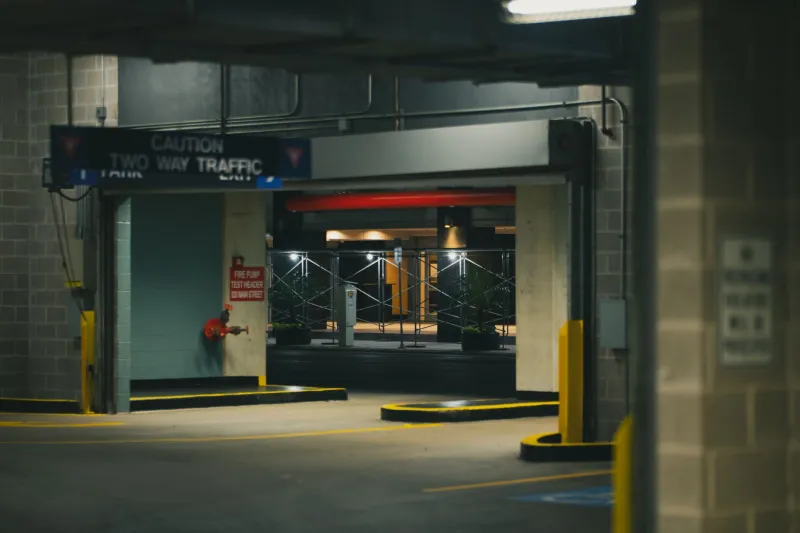
America watches itself constantly. There are an estimated 70 million surveillance cameras operating across the United States at any given moment — mounted above convenience store registers, fixed to parking garage ceilings, blinking quietly in the corners of hospital lobbies and hotel corridors. They record everything. They forget nothing. And for a growing number of security professionals working the overnight hours, that relentless documentation has produced something no one anticipated: evidence of a figure that should not exist.
He — or it — appears without warning. Always alone. Always unhurried. And always wearing the same expression: a wide, fixed smile that does not shift, does not falter, and does not belong to any face that anyone has ever been able to name.
The Reports Begin
The first documented account to gain serious traction within private security circles emerged from a strip mall in suburban Ohio. A overnight guard reviewing footage from a Tuesday in late autumn noticed a man walking through the parking lot at 2:47 a.m. The figure moved at a measured pace, hands at his sides, head turned slightly toward the nearest camera. The smile was, by the guard's own description, "too wide and completely still, like it had been painted on."
What made the footage notable was not the figure's appearance alone. It was the timestamp. That same morning, a colleague working a hotel property in central Tennessee — more than 500 miles away — flagged nearly identical footage. Same build. Same gait. Same expression. The timestamp: 3:12 a.m.
Neither man had spoken to the other before comparing notes. Neither had any explanation for what they had seen.
These reports, circulating through informal networks of security professionals and eventually surfacing on several closed online forums dedicated to surveillance anomalies, share a constellation of details so consistent as to be deeply disturbing. The figure invariably appears in the early morning hours, most frequently between 2:00 and 4:00 a.m. He does not interact with other individuals present in the footage. He does not enter any building. He simply passes through the frame — always aware of the camera, always smiling — and disappears beyond the edge of the image.
The Impossibility at the Center
What transforms these accounts from unsettling curiosities into something considerably darker is the matter of simultaneity. Investigators who have attempted to map the sightings geographically have encountered a problem that resists ordinary explanation: the figure appears in locations that no single human being could physically reach within the timeframes recorded.
In one cluster of incidents documented over a six-week period, the figure was captured on footage from a gas station in rural Montana, a university parking structure in North Carolina, and a 24-hour pharmacy in suburban Arizona — all within a span of roughly 90 minutes on the same night. The distances involved make conventional travel not merely improbable but mathematically impossible.
Some researchers have suggested that the explanation is mundane — that security professionals are experiencing a form of collective apophenia, the well-documented human tendency to perceive meaningful patterns within unrelated data. According to this view, a sufficient number of late-night cameras will inevitably capture unremarkable strangers who, when filtered through exhausted and suggestible minds, begin to resemble one another in ways that feel significant but are not.
It is a reasonable argument. It is also one that the footage itself does not entirely support.
What the Cameras Actually Show
Several of the recordings have been subjected to informal analysis by individuals with backgrounds in video forensics. Their findings, while far from conclusive, are difficult to dismiss outright. In multiple instances, the figure's facial geometry — the distance between the eyes, the width of the jaw, the precise curvature of that unrelenting smile — appears consistent across recordings made on different camera systems, under different lighting conditions, in different states.
Facial recognition software, when applied to the available footage by those with access to such tools, has returned no matches in any public or law enforcement database. The figure has no name, no record, and no traceable history. He exists only on the recordings — and nowhere else.
The smile itself has attracted particular attention. Human facial expressions, even forced or deliberate ones, involve micro-movements: slight fluctuations in muscle tension, minor asymmetries that shift across the duration of an expression. The smile captured on this footage does not behave this way. Frame by frame, it remains perfectly, unnervingly static — as though it were not an expression at all, but a feature.
The Psychological Weight of Being Watched Back
For the security professionals who have encountered this footage firsthand, the experience carries a psychological dimension that extends well beyond professional unease. Several have described a persistent sensation that the figure was not merely visible on camera, but was in some meaningful sense aware of being recorded — that the encounter was not incidental but intentional.
This perception touches on something deeply embedded in the American relationship with surveillance culture. The cameras were installed to provide safety, to create a record, to assert a measure of control over spaces that might otherwise feel vulnerable in the dark hours. They represent a promise: that nothing will go unseen, that the night will be held accountable to the light.
What happens, then, when the thing being recorded appears to understand that promise — and to find it amusing?
The fixed smile suggests not menace in any conventional sense, but something potentially more disturbing: indifference to discovery. Whatever this figure is or represents, it does not appear to be hiding. It walks through the frame with the unhurried confidence of something that has never needed to conceal itself, that has always known the cameras were there, and that has never once considered them a threat.
The Darkest Implication
There is a final possibility that the most cautious investigators have been reluctant to articulate directly, though it surfaces in the margins of nearly every serious discussion of this phenomenon. It is this: that the figure appearing on these recordings is not a person at all in any sense that current understanding can accommodate — that it is instead something that has learned to move through the documented world precisely because documentation is now so total, so relentless, and so thoroughly unexamined by the humans who nominally oversee it.
America's surveillance network was designed to watch. It was not designed to question what it sees. The algorithms flag motion, log timestamps, and archive footage in servers that no human eye will ever review. In that vast, unmonitored archive, something may have found a kind of freedom — the freedom to move through a nation's recorded memory without consequence, without identity, and without end.
The cameras keep running. The smile never changes. And somewhere in the dark hours between two and four in the morning, in a parking lot or a corridor or a quiet stretch of road in a state you may well call home, the figure is almost certainly walking through another frame right now.
Still smiling. Still watching. Still completely, impossibly present.